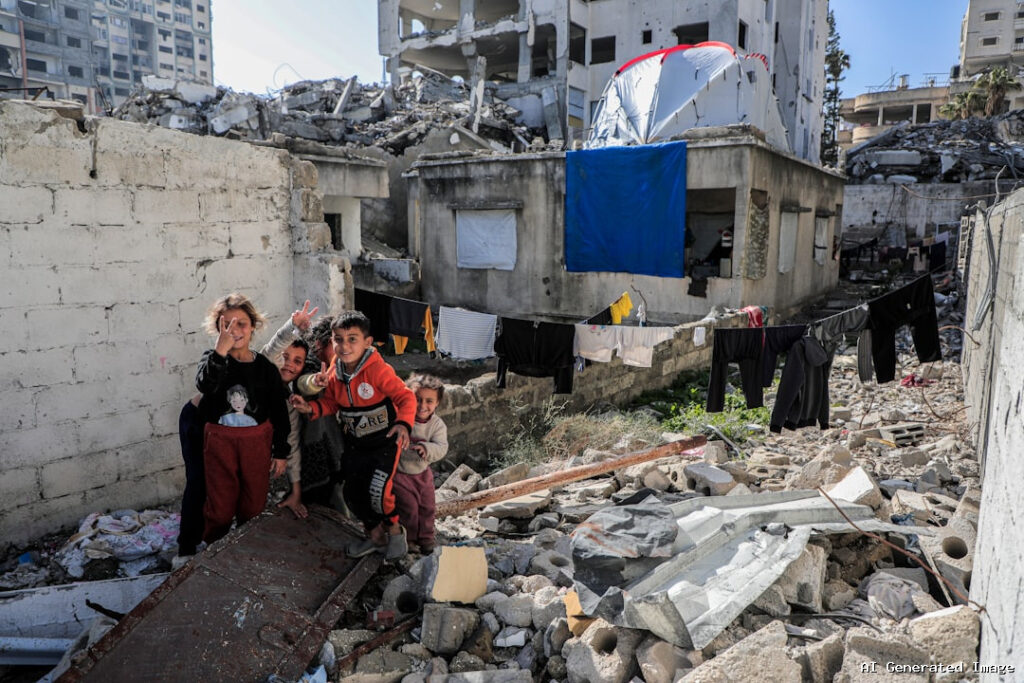
Gaza Reconstruction Project Sparks Debate on Partition and Humanitarian Relief
The Gaza Reconstruction Project, a multi-billion-dollar initiative aimed at rebuilding and revitalizing the war-torn Gaza Strip, has sparked intense debate among policymakers, human rights activists, and local residents. While the project promises to provide much-needed relief to tens of thousands of Palestinians who have endured two years of conflict, it has also raised concerns about its potential to solidify the partition of Gaza into Israeli- and Hamas-controlled zones.
A Complex History of Occupation and Conflict
To understand the significance of the Gaza Reconstruction Project, it is essential to delve into the complex history of the Israeli-Palestinian conflict. The Gaza Strip, which has been under various forms of occupation since 1948, has been a focal point of tensions between Israel and Hamas, a militant group that has controlled the territory since 2007. The region has experienced multiple rounds of violence, including a devastating war in 2008-2009, 2012, and 2014, resulting in widespread destruction and displacement of civilians.
The Gaza Reconstruction Project: A Step towards Humanitarian Relief
The Gaza Reconstruction Project, launched in 2020, is a joint initiative between international donors, including the United States, the European Union, and the United Nations. The project aims to rebuild and restore essential infrastructure, including homes, schools, hospitals, and roads, which were severely damaged or destroyed during the recent conflicts. According to the United Nations, the project has the potential to benefit over 1.3 million Palestinians living in Gaza, who have been struggling to access basic necessities such as food, water, and healthcare.
Partition and the Gaza Reconstruction Project: A Concerning Trend
While the project has been hailed as a vital step towards humanitarian relief, many have raised concerns about its potential to entrench the partition of Gaza into Israeli- and Hamas-controlled zones. Critics argue that the project will only serve to legitimize the existing power dynamics, perpetuating the division between Gaza and the West Bank, and undermining the prospects of a two-state solution. Furthermore, the project’s reliance on international funding and assistance raises questions about the long-term sustainability of the initiative and the extent to which it will address the root causes of the conflict.
A Future of Uncertainty and Complexity
As the Gaza Reconstruction Project unfolds, it remains to be seen whether it will achieve its stated goals of providing humanitarian relief and rebuilding infrastructure. However, the project’s potential to solidify the partition of Gaza and perpetuate the existing power dynamics is a concern that cannot be ignored. In the absence of a comprehensive peace agreement and a lasting resolution to the Israeli-Palestinian conflict, the future of Gaza and its inhabitants remains uncertain and fraught with complexity.
Conclusion
The Gaza Reconstruction Project is a complex and multifaceted issue that raises important questions about the nature of humanitarian relief, the role of international donors, and the prospects for a lasting peace in the Middle East. While the project has the potential to provide much-needed relief to tens of thousands of Palestinians, it also risks entrenching the partition of Gaza and perpetuating the existing power dynamics. As policymakers and human rights activists continue to navigate this sensitive issue, it is essential to prioritize a comprehensive and inclusive approach that addresses the root causes of the conflict and promotes a durable and just peace for all parties involved.